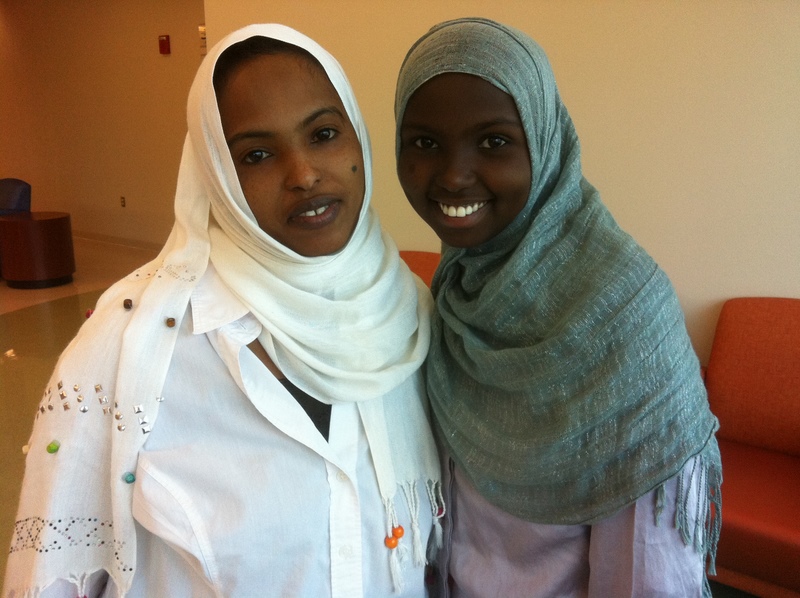
ESL (English as a Second Language) class was today. The class is held at our “D2” apartment every Wednesday and Friday from 10AM to 12. You see, once I started teaching Asha English in her home (see the About Page for details) the word got out. The relationships I had developed with several refugee students in the Catholic Charities ESL class were sincere, real and they knew it. There were other ESL volunteer teachers (especially my friend Tricia) who also began to build great friendships with refugees. When students began to see us walk around their apartment their faces just lit up with smiles. “Teacher! My teacher!” they would say. It seemed as though the refugees were proud to call me or Tricia their American friend.
My refugee friends are always extremely hospitable. I have learned that for most of them good hospitality is part of their culture. Most of the time when I visit refugees, I am greeted then asked to have a seat while tea, sweet treats or fruits are prepared. So far, I am always welcomed into their homes.
I started out with only one student – Asha. Asha’s disabilities kept her from being able to physically get to the classes at Catholic Charities. As I visited with Asha and practiced English we would often run errands together, go to doctor appointments and have lunch together. Asha would play a great game of charades with me so that we could communicate. When she would get frustrated, shake her head, and throw her hands up in the air, I would encourage her not to give up and keep trying to communicate with me. We would draw pictures, make weird facial expressions, funny body movements and point to objects sometimes. I was determined and Asha fought with me. We learned all kinds of things about one another without being able to speak the same language. The way Asha and I communicate still amazes me! What Asha and I learned together in her home about communicating with someone when language is an issue was a talent I seemed to take with me as I built other friendships with non English speaking people. I believe it has become a real gift and I treasure it and truly thank God for it. (My secret: It’s God. Not me. I prayed a long time ago and asked God to help me to somehow be able to communicate with, connect to and understand my refugee friends. I asked God to not allow language to be a barrier in my friendships as I try and shine His loving light in a dark world and above all for His Will Be Done in me. I realize that apart from God I can do nothing.)
Asha began inviting her friends in her home to practice their English with us. I invited my friend, Vivian, to come help me and meet Asha and Asha’s friends. Our number of students increased each week. Since we were in Asha’s home and we were all females, we decided to strictly make the English in home classes for ladies. Many of the students were mothers. Some of the mothers were mothers of children with disabilities. Some of the mothers were single moms. Some were single moms with many children. As Vivian and I got to know and work with some of the pre-school children, we realized that the children needed to
learn English and get prepared for Kindergarten. Vivian began working with the preschoolers in Asha’s home while I tutored the mother’s English. We quickly
outgrew Asha’s apartment. Since one of the moms we tutored lived next door to Asha, sometimes Vivian would take the children to her house. It worked pretty
well for a while, but our numbers kept growing. We needed more space.
Men and women in the refugee community began to come to me to ask for help with what I thought to be simple American tasks that most American
mom’s and dad’s would know. Refugees need more than just english help.
Other than ESL, some of the refugees most common needs were and still are today:
- help understanding mail (especially bills and doctor appointments)
- help training for, applying for or obtaining a job (writing a resume)
- basic education and GED assistance, tutoring and testing
- help learning computer skills
- a person to practice driving skills, help obtaining their driver’s license
- understanding their automated food stamp allowance and getting food when it hasn’t started yet or runs out
- help setting up their TV’s
- getting more clothes, shoes, blankets, toiletries, furniture and other household items
- help understanding how to set their central air system to keep their utility bill low
- childcare (mentoring mom’s – discipline help)
- help repairing and buying cars
- help making doctor’s appointments and getting to doctor’s appointments
- learning how to use the bus system
This brings me to Apartment D2. I advocated with my husband and then church, Nations Memphis (www.nationsmemphis.tv), to get an apartment within the refugee community. My refugee friends had welcomed me into their homes for so long and I wanted a way that I could return their generosity. I wanted to invite them into my home. Although I had brought refugees in my home before, it was too difficult to transport refugees back and forth 40 minutes to and 40 minutes back. Gas had gotten expensive. I needed a place that my friends, my church and I could be available to respond to the many needs in the refugee community. And so, we worked out a deal with the apartment owner to have an apartment.
The apartment wasn’t exactly ready for us to take possession of it. Our deal was that our church would fix up the apartment in exchange for rent. Like most of the other apartments in this community, it was bug infested and dirty. We had to go in and bug bomb it, pull out rotting wood, repair floors, paint and clean it. Then we had a terrible plumbing issue that kept us from actually getting into the apartment for several months. The floors were buckled and damaged by the water. After several months not being able to get into the apartment for ESL, I decided I should focus on my in home tutoring at Asha’s. I had almost given up on that apartment. I was actually looking at other locations. And then, one day, the apartment owner hired a plumber to fix the plumbing and then Operation Broken Silence had a team of individuals who provided a lot of labor and better flooring. They will never really understand how much they helped us out! Thank you Operation Broken Silence!
And so, we are in our apartment. D2. We call it the Nations United: Hope Center at church. It’s been several months since we’ve been in the apartment. But, we’ve outgrown it. The apartment is three bedrooms. The main room is packed with about 16 chairs that are usually always full of students. In this room we have three standard rectangle portable tables. One table is for students at a beginner level, which often means they have never held a pencil and cannot write their name. One table is for a middle level, which often means they can write their name and alphabet and are trying to sound out the letters and begin to read. I’ve got rotating teachers for the beginner and middle level classes. Our advanced level is about on a 2nd grade level. They are reading and writing, but need help with their grammar, comprehension, vocabulary and speaking confidence. My friend, Deborah, teaches the advanced class as she is good at getting serious with reading and grammar.
We also began helping the Spanish Community that lives in the same apartment complex with their English. My friend Terry has taken charge of the Spanish classes. She teaches them English on Tuesday nights then Wednesday and Friday mornings in one of the smaller back bedrooms and is often packed in. We figure we are there helping adults learn English and wouldn’t want to not involve our Spanish friends who also need a little help.
During class times, the other two rooms and the outside courtyard are full with children. We have a volunteer staff that helps us that rotates on any given Wednesday and Friday. A few teachers help both Wednesdays and Fridays. We’ve had a lot of sweet mom’s and creative youth helping us out with our children during the summer. I’m not sure what we will do during the school year.
Saturday mornings at 10AM, we’ve started a beginner computer class. Chris and Leah lead it. They have three laptops that they set up in the apartment and teach students how to maneuver on a computer. The men seem to enjoy this class. We need more volunteer teachers and computers.
The needs of vulnerable refugees keep growing. More refugees are coming to the Memphis area and will need help. Many will have disabilities, multiple children or no education. They need a hand to hold. They need a friend. I think it’d be great for each refugee to have an American God loving mentor. Asha’s Refuge doesn’t want to only focus on teaching English (although that part of it is a huge need for refugees). Asha’s Refuge wants to provide hope in situations in a refugees life where they see no help. I’m just an ordinary American mom, but somehow I and the other volunteers at Nations United: Hope Center and Asha’s Refuge are so helpful to this group of very special people.
(Note: The Nations United: Hope Center is a ministry under Lord of the Nations Church in Memphis, TN (www.nationsmemphis.tv). It is a ministry I led that began to grow bigger and faster than what my church was able to really support. The refugee needs are great. My church still has a heart to help refugees and will serve as they can. I spoke with my Pastor and prayed about starting Asha’s Refuge in order to better cater to a particular group of needy refugees. Please see the “About Asha’s Refuge” page for additional details. I still serve in my churches refugee ministry as it fits right alongside of where my heart is for refugees as a whole.)