Yesterday was so busy for me that I wasn’t able to sit down and write. I received a phone call from Abby, my Somalian speaking refugee friend from Yemen, who was trying to take her daughter, Alia, to an important doctor appointment. Last Wednesday I handed Aby a referral from her primary doctor for her to go to this special doctor to do diagnostic testing. My friend, Tricia and I drew out a simple map and slowly explained to Abby how to get to the doctors office since neither of us would be available this time to take her. It seemed easy: Go East, down Poplar Ave. for ten minutes, turn left on Estate. The Lebonheur office is right there. We also gave her specific instructions not to be late for the 8AM appointment. Abby seemed nervous but willing to try after our encouragement.
Let me first explain Abby’s medical situation. Without sharing too many details about Alia’s private situation, I feel it’s okay to share the obvious. At age 2, little Alia came in as a refugee. That was about a year ago.
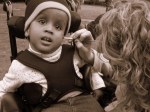

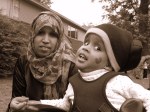
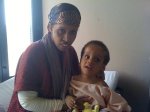
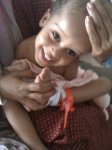
She had and still has a medical condition where there is too much fluid that surrounds her brain and causes the head to swell called, Hydrocephalus. Alia’s head is oversized and too heavy for her weak neck muscles to hold up. This condition could’ve been corrected early in Alia’s life if the medical assistance would have been available. The war and poverty situation in Yemen/Somalia didn’t offer Alia any promises to treatment. By the time Abby and Alia obtained refugee status to come to America and get help, the fluid in her brain had already damaged too much of the brain. There was no surgery that could turn back the damage. Alia would live a low functioning life (probably never walk or feed herself) and her body would be easily prone to pneumonia. In addition, after about 7 months, we found out Alia’s food was not traveling to her stomach but was in fact spilling out into her lungs. For survival, she had to get a feeding tube. All of this news and understanding how to care for Alia has been extremely difficult for Abishiro. My friend, Melanie, is her advocate. She’s befriended Abby and Alia and offered a lot of encouragement, real help,support, and love. Asha’s Refuge needs lots of Melanie’s to help out struggling refugees.
Anyhow, Abby called me about 9:30, lost! Ack! She had gotten a friend of hers who spoke a tiny bit of English to drive so she could follow him to be sure she knew where she was going and then he had to leave and be at work by 10. They were both very lost! I spoke to Abby’s friend and learned they had first taken Poplar the wrong direction and ended up in downtown Memphis by the Mississippi river. They figured out they went the wrong direction on Poplar and turned around. They then drove past Estate on towards Ridgeway, about 8 minutes out of the way. I tried speaking to the gentlemen on the phone but he was frustrated and screaming as he spoke to me in a mix of Somalian and English. I had to calm and slow him down in order to figure out where he was. (This reminded me of myself when I have called my husband in the past when I was lost and so frustrated that he could not calm me down to help me. Funny how the tables were turned). I also spoke to Abby (well sort of) and could tell she was scared and frustrated. The two of them had been driving around for near two hours and it should’ve only taken them about fifteen minutes.
Trying to give a non-English speaking person help in this situation was really challenging. I am directionally challenged too! I got them across the street from the doctor’s office and couldn’t get them to understand “across the street”. After a few minutes on the phone they stopped and gave the phone to lady at a gas station to talk to me so I could point them in the right direction. Finally, they had arrived. It was near 10:00AM.
I quickly realized the time and knew that the doctor would probably not appreciate their 2 hour late arrival to see him and would decline their visit. I knew that Abby would not be able to speak to them to explain what happened. I really hoped the doctors office wouldn’t turn her away. I hung up with Abby and searched for her doctors phone number on google. I called the office (which was an automated machine with a long voice message of extensions to press at first-ughhh), explained their situation and begged them to please see this young girl. The nurse said, “As long as she can get here by 10:30 because our doctor leaves then”. Great, I thought. They are there and should be coming in any moment. I hung up the phone.
My phone rang again. It was Abby. They were in the correct place, the strip of doctors offices in a cove, but couldn’t find 806! “Look around for numbers, what do you see Abby?” Abby didn’t know what I was saying. I decided to hang up and call the doctors office back to ask if someone could walk outside in the cove to physically get them. Again, I received the voice answering service, then I was directed to a different lady that ended up not understanding what I needed and gave me back to my original nurse. She agreed to go out and get them. I called Abby back and said, “Wait there where you are. A nurse is coming to get you!” The nurse found her and spoke to me on Abby’s phone. We were all relieved!
At one point early in the fiasco, I wanted to drive to Abishiro (35 min for me) to help her. But I had my own children with me trying to get them to a dental appointment. I felt so bad for Abby and her friend who was now late for work. I should’ve taken Abby on a test run to her clinic Wednesday after ESL class.
The doctors office gave Abby a prescription for Alia. Other than that, Abby isn’t really sure what they did or advised for her daughter. The medicine would cost $400 if insurance wouldn’t pay it. Abby needed help talking to a Walgreens pharmacist. During ESL class today, I decided to watch Alia for Abby while a new friend of mine, Rebecca, took her to Walgreens. The medicine would be filled in a few days if insurance would approve it. We will find out next week after the July 4th Holiday.
Many refugees with children who have disabilities need extra help. They need help maneuvering through the American medical systems. It may seem easy to us (Americans) but it can be extremely difficult for foreigners especially if they lack English speaking abilities and have a disability or are not educated. Asha’s Refuge will work hard to help fill this major medical gap in the refugee resettlement system by closely partnering with medical organizations and staffing volunteers to provide special assistance for disadvantaged refugees.
 Asha's Refuge
Leave a comment